

What Is a Laser Distance Meter
A laser distance meter is a portable electronic measuring tool that uses a laser beam to quickly and accurately determine the distance between two points. Also known as a laser rangefinder or laser tape measure, it has largely replaced traditional metal tape measures and become an indispensable tool in construction, real estate, engineering, and other fields.
Working Principle
The laser rangefinder emits a focused laser pulse (or continuous laser beam). When the laser strikes the target, it reflects back to the instrument. The instrument calculates the distance using the Time-of-Flight (TOF) method: Distance = (Speed of light × Round-trip time) ÷ 2 The speed of light is approximately 300,000 kilometers per second. The instrument must measure nanosecond-level time intervals to achieve millimeter-level accuracy. Some models also employ phase-shifting technology, calculating distance by comparing the phase difference between the emitted and reflected laser beams.
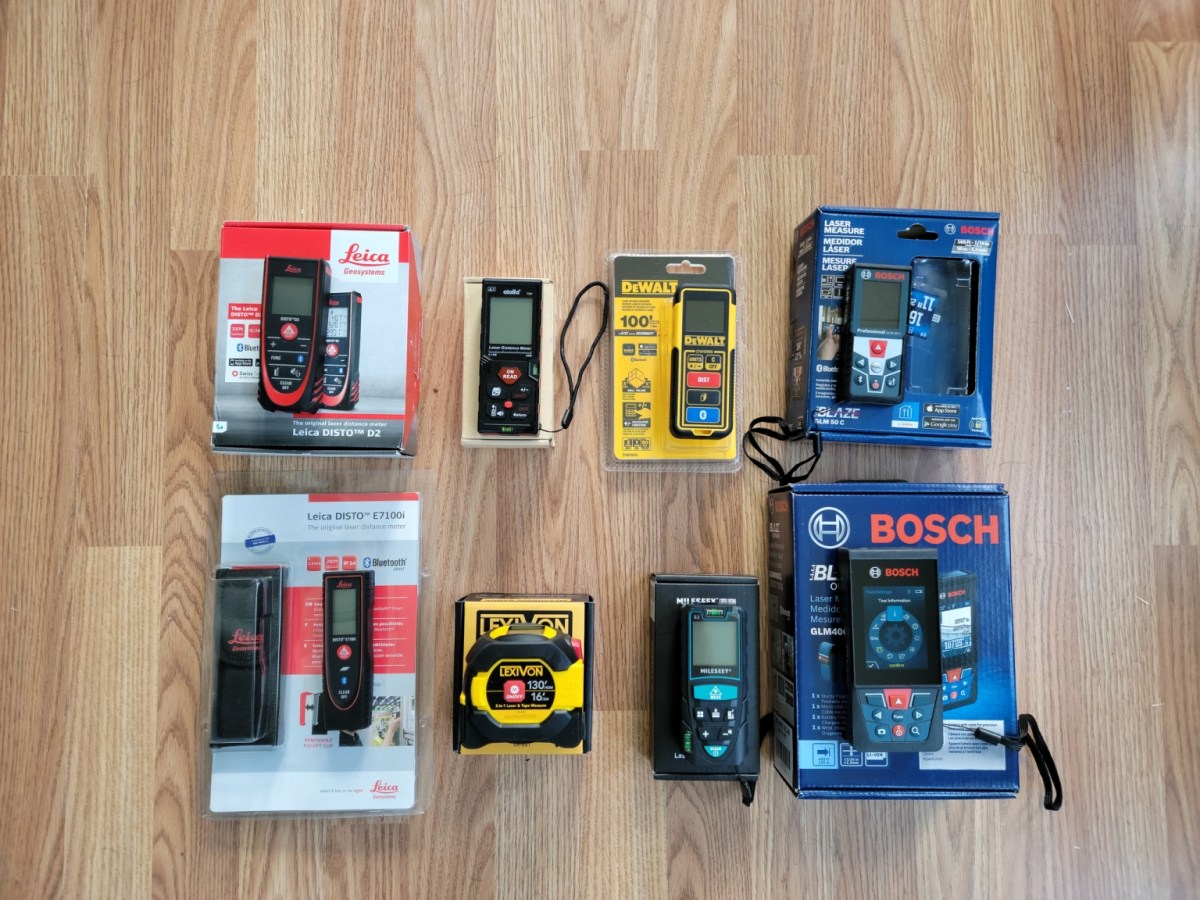
Below are examples of the appearance of common handheld laser rangefinders (from leading brands such as Leica, Bosch, Fluke, DeWalt, Kiprim, etc.):

Key Facts and Technical Specifications
- Measurement Range: Handheld models typically measure 10–200 meters (some high-end models reach up to 650 feet/198 meters), while professional long-range models can measure several kilometers.
- Accuracy: Typically ±1–2 millimeters (or 1/8 inch), significantly outperforming traditional tape measures (which bend easily and require two people to operate).
- Additional Features: Automatic area and volume calculation, Pythagorean theorem, continuous measurement, Bluetooth data transfer, tilt sensor, dustproof and waterproof (IP65+).
- Advantages: Single-operator use, rapid readings (seconds), accessible for high/confined spaces, contactless safety, eliminates ladder climbing or tape extension.
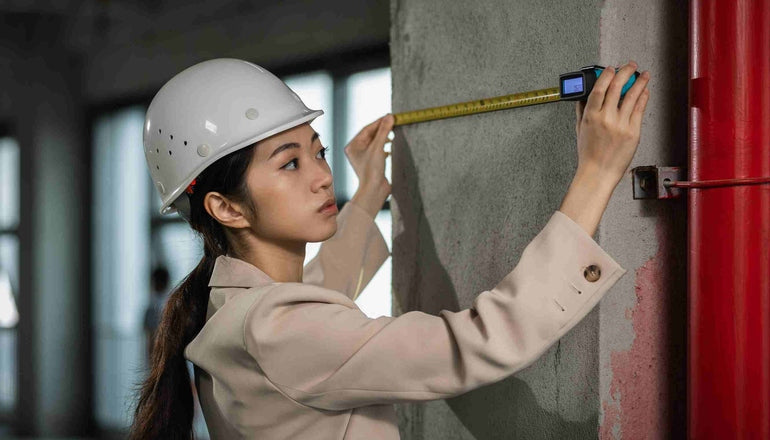
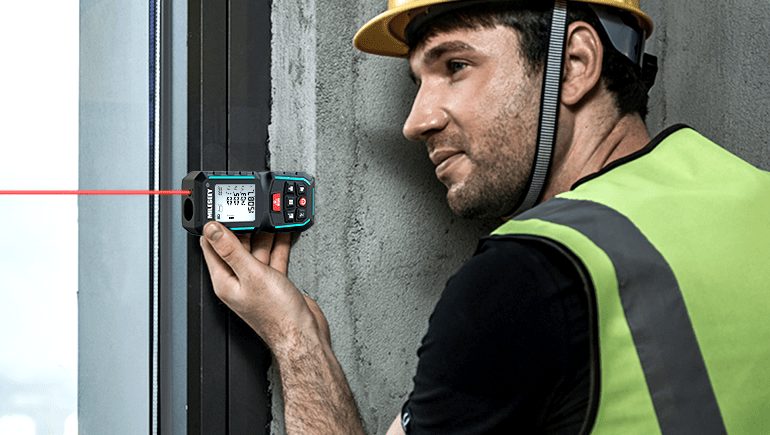
Examples of laser rangefinder applications in real-world scenarios (construction workers measuring wall or room distances):
Historical Background
In 1993, Swiss company Leica Geosystems launched the world's first handheld laser distance meter—the Leica DISTO. It featured a measurement range of approximately 30 meters (100 feet), accuracy of ±1/8 inch (about 3 millimeters), and weighed around 2 pounds. Rapid iterations followed: Bluetooth connectivity, a 360° tilt sensor, backlit display, and waterproof/dustproof design were added. The company also established the ISO 16331-1 international standard to ensure reliable accuracy in real-world conditions. Today, these devices have become ubiquitous across both consumer and professional markets.
Practical Application Areas (Selected Examples)
- Construction and Building: Measuring room dimensions, trench depth, material estimation (paint, flooring, insulation), ceiling height, crane positioning.
- Real Estate and Appraisal: Quick square footage calculations, floor plan verification, outdoor landscaping/pool measurements.
- Electrical/HVAC/Plumbing: Cable length, pipe routing, safety clearances, equipment volume calculations.
- Other: Forestry (through-leaf measurements), Sports (golf distance), Industrial Maintenance (tank levels, conveyor belt lengths).
Real-world Case Studies and Data
- Large Commercial Property Inspection (Real Estate): Using the Leica DISTO X6 (400-foot range, Bluetooth), inspectors completed measurements of expansive office areas and conference rooms in a single pass, eliminating multiple trips and significantly saving time and physical effort.
- Residential Renovation Project: Utilizing the Bosch GLM165-40 Blaze (165-foot range), inspectors precisely measured existing kitchen and bathroom dimensions. Automatic area and volume calculations assisted designers in planning new layouts, preventing material waste.
- Outdoor Property Listings: The CIGMAN 393-foot green-light outdoor model (with 4x camera) rapidly maps gardens, patios, and pool areas, providing accurate dimensional data for property listings to boost buyer interest and closing rates.
- Construction Estimation Scenarios (Fluke Application Case Summary): Electrical engineers use laser distance meters to measure high-voltage line safety clearances, cable route lengths, and ceiling rod dimensions, replacing traditional tape measures and wheeled distance meters. This reduces the need for two-person collaboration and minimizes human error. On-site construction teams directly estimate paint/flooring quantities and trench depths, enabling more precise bidding and material lists.
How Laser Distance Measurement Works
How Laser Distance Measurement Works Laser distance meters (also known as laser rangefinders or laser distance gauges) primarily rely on two core physical principles: Time-of-Flight (ToF) and Phase-Shift. Both methods leverage the extremely high speed of light (approximately 299,792 km/s) to calculate distance by measuring the “delay” between the laser's emission and its reflection.
1. Time-of-Flight, ToF / Pulse Method
This is the most intuitive and common principle, particularly used in medium-to-long-range or professional-grade rangefinders (such as certain outdoor models or LiDAR systems). Working steps:
- The instrument emits an extremely short laser pulse (typically in the nanosecond range).
- After the pulse strikes the target surface, a portion of the light is reflected back.
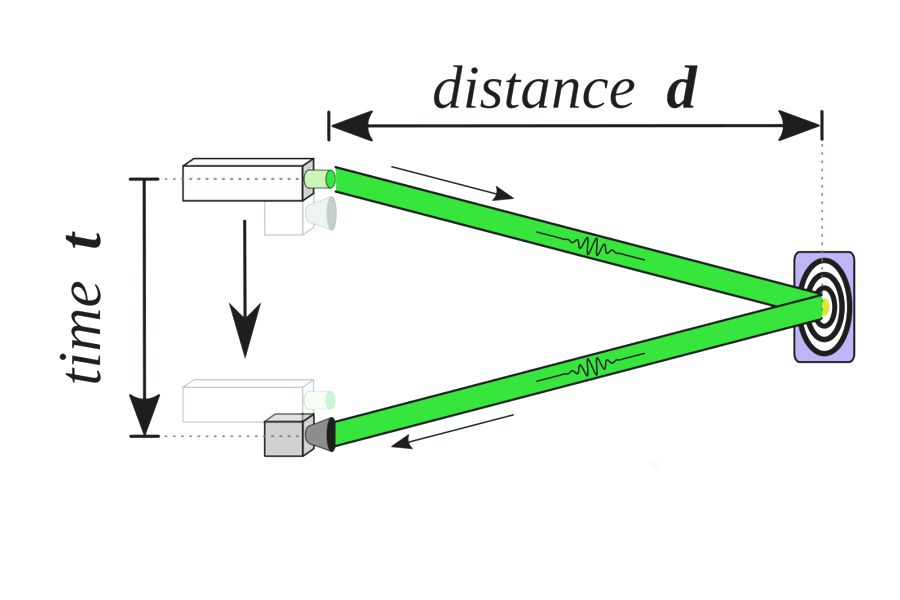
- The instrument's high-precision timer measures the total round-trip time t of the pulse.
- The formula for calculating the distance d is:
d = (c × t) / 2
Here, c represents the speed of light (approximately 3 × 10⁸ m/s). Dividing by 2 accounts for the fact that light travels twice the distance—once outward and once back.
Real-world accuracy examples:
- Nanosecond-level time resolution → Distance accuracy achievable at the centimeter or even millimeter level.
- This method is commonly used for long-range applications (e.g., several kilometers) as it is not constrained by phase ambiguity.
Schematic diagram of principle (ToF pulse round-trip process):
2. Phase-Shift Method
This is the primary principle employed by most handheld laser distance meters (such as mainstream consumer/professional models like the Leica DISTO series, Bosch GLM, and DeWalt), as it offers higher accuracy, lower power consumption, and better suitability for diffuse surfaces within the 0–200-meter range.
Operating steps:
- The instrument emits a continuous laser beam whose intensity is modulated by a sine wave (typically at frequencies ranging from tens to hundreds of MHz).
- When the laser hits the target and reflects back, the receiver detects the intensity modulation signal of the reflected light.
- Due to the time delay caused by light propagation, the reflected signal experiences a phase shift φ relative to the transmitted signal.
- The relationship between phase shift and time delay t is: t = φ / ω (where ω is the modulation angular frequency).
- Substituting into the distance formula: d = (c × φ) / (2ω)
Key Features:
- Exceptional accuracy (typically ±1 mm), as phase measurement enables sub-nanosecond resolution more readily than direct timing.
- However, “phase ambiguity” arises when the distance exceeds half the modulation wavelength's period, leading to multiple solutions. Multi-frequency modulation is commonly employed to resolve this ambiguity.
- Leica Geosystems Official Explanation: The Leica DISTO series employs phase measurement principles by emitting a defined wavelength light pulse sequence, achieving high precision through phase comparison.
Schematic of Phase Shift Method (emitted vs. reflected waveform comparison, phase difference Δφ corresponds to distance):

Comparison of Two Principles
- ToF (Time-of-Flight): Suitable for ultra-long ranges (kilometer-level) and strong anti-interference capabilities, but with slightly lower accuracy and higher power consumption. Commonly used in military/industrial LiDAR.
- Phase-Shift (Phase Method): Suitable for handheld devices at 0–200 m, offering millimeter-level accuracy, single-operator capability, and high cost-effectiveness. This is the mainstream technology in over 95% of commercially available home/construction-grade laser rangefinders.
Actual Cases and Documentation
- Official Principle of the Leica DISTO Series
Since the 1990s, Leica has employed the phase measurement principle. A laser diode emits modulated light pulses at a specific wavelength, calculating distance through phase difference. This has become an industry standard, with many brands (such as Bosch and Hilti) following a similar technological path. - Real-World Construction Site Applications Construction workers use phase-based laser distance meters to measure ceiling heights or room diagonals: With a single button press, the instrument completes phase comparison within 0.5–2 seconds, displaying results with ±1.5 mm accuracy. This is 5–10 times faster than traditional tape measures while delivering lower error rates (tape measures are prone to bending and significant human reading errors).
- Robotics and Industrial Automation Applications Hokuyo or Acuity laser sensors are commonly used for obstacle avoidance in AGVs (Automated Guided Vehicles): Employing ToF or phase-based methods, they monitor distances to obstacles 10–30 meters ahead in real-time with millimeter-level precision, enabling robots to dock accurately or avoid workers.
- Extreme Environment Case (Aerospace-Grade Extension) ESA's LISA (Laser Interferometer Space Antenna) project employs ultra-high-precision laser interferometers (similar to phase-based extension) to measure micrometer-level distance variations between three spacecraft separated by 2.5 million kilometers, enabling gravitational wave detection. This demonstrates the potential of laser ranging principles under extreme precision demands.
These principles, formulas, and case studies can be directly applied to content development under the H2 heading, offering both scientific rigor and practical utility. Should you require more detailed mathematical derivations, explanations of multi-frequency demultiplexing, specific brand teardown diagrams, or additional industry case studies, please let me know!
Types of Laser Distance Measuring Tools
Laser distance measuring tools (also called laser distance meters or laser distance measurers) use laser beams and different measurement principles to quickly and accurately measure distance. They are widely used in construction, renovation, industry, surveying, military applications, forestry, and other fields. Compared with traditional tape measures, they are more efficient and precise, typically achieving an accuracy of ±1–3 mm.
According to reliable sources, laser distance measuring tools can mainly be classified as follows:
1. Classification by Measurement Principle (Core Technical Classification)
-
Pulse / Time-of-Flight (TOF)
This method emits a laser pulse and calculates the distance by measuring the time it takes for the pulse to travel to the target and return. It is suitable for medium- to long-distance measurements (from dozens of meters to several kilometers or even tens of kilometers). It offers high accuracy and is commonly used in outdoor applications, military operations, and surveying. However, its accuracy at very short distances can be slightly lower. -
Phase Shift Method
This technique calculates distance by analyzing the phase difference of a modulated laser beam. It provides extremely high precision (millimeter-level or even micrometer-level). It is suitable for short to medium distances (typically less than 100–200 m) and is the most common method used in consumer and professional handheld laser distance meters. -
Triangulation Method
A laser beam is projected onto the target surface, and the distance is calculated based on the position shift of the reflected light on a sensor. This method is ideal for short-distance, high-precision measurements (from a few centimeters to several tens of meters). It is commonly used in industrial precision measurement, displacement sensors, and automation systems.
2. Classification by Application or Use Case
-
Handheld Laser Distance Meters
The most common type. These devices are portable and compact, typically offering a measurement range of 20–300 m (high-end models can exceed 200 m). They are widely used for interior design, construction, real estate measurement, renovation, and DIY projects.
Common features include addition/subtraction calculations, area and volume measurement, Pythagorean (indirect) measurement, continuous measurement, data storage, and Bluetooth connectivity.
Typical brands include Leica DISTO, Bosch GLM, DeWalt, and Stabila. -
Telescopic / Long-Range Laser Rangefinders
These devices combine a laser rangefinder with a telescope, allowing measurements of 500–3000 m or more (military models may reach 20 km+). They are used for hunting, golf, forestry, military applications, surveying, and terrain exploration. Many models include angle or height compensation and speed measurement using Doppler technology. -
Industrial / Fixed Laser Distance Sensors
Designed for durability and strong interference resistance, these sensors are used in factory automation, machine positioning, material level monitoring, and long-term industrial measurement tasks. They are often integrated into production lines and support analog or digital output signals. -
Special-Feature Models
Some devices include additional functions such as Bluetooth or app connectivity, smart calculations, green laser technology (better outdoor visibility), dust and water resistance (IP65+), and built-in cameras or targeting scopes.
3. Classification by Laser Type / Color
-
Red Laser
The most common type. It is cost-effective and clearly visible indoors, but visibility may decrease under bright outdoor sunlight. -
Green Laser
Offers higher visibility because the human eye is more sensitive to green light. It is more suitable for bright environments or longer distances, though it generally has higher power consumption and cost.
4. Other Common Subcategories
-
Indoor vs. Outdoor Models
Outdoor models typically include stronger lasers, tilt sensors, and target enhancement optics for better long-distance performance. -
Consumer / DIY vs. Professional Models
Consumer models usually have shorter ranges and basic functions, while professional models offer higher accuracy, greater durability, and more advanced features. For example, Leica devices are known for their high precision but come at a premium price, while Bosch products often provide strong value for money. -
Hybrid Models
A few products combine laser measurement with a traditional tape measure (hybrid laser tape measures), although pure laser devices remain the mainstream option.
Summary
For home use or interior renovation, a handheld phase-shift laser distance meter with a 50–200 m range is usually the best choice, especially if it supports Bluetooth connectivity for easier data transfer.
For long-distance or outdoor measurements, a pulse-based telescopic rangefinder is more suitable.
For industrial precision applications, triangulation-based sensors or dedicated industrial laser distance sensors are recommended.
When selecting a device, key factors to consider include measurement range, accuracy, waterproof rating, tilt/area calculation capabilities, and brand reputation.
Common Measurement Ranges
Laser distance meters are available in several measurement ranges depending on their intended use. Entry-level and DIY models typically measure 20–50 meters, making them suitable for indoor tasks such as home renovation and furniture layout. Mid-range professional models usually offer 60–100 meters, which are ideal for construction, real estate measurement, and interior design projects. Advanced handheld models can reach 150–300 meters and are designed for larger construction sites or outdoor measurements. For specialized applications, long-range laser rangefinders can measure 500 meters to several kilometers, commonly used in surveying, forestry, and military operations. Choosing the appropriate range ensures both accuracy and efficiency for the specific measurement scenario.
Applications
The use of laser distance meters is widespread across many industries due to their speed, accuracy, and ease of operation. In construction, they help measure room dimensions, building heights, and site distances quickly and precisely. For interior design, laser distance meters are used to measure spaces for furniture placement, flooring, cabinets, and lighting layouts. In DIY projects, homeowners rely on these tools for tasks such as measuring walls, hanging shelves, or planning home renovations. In engineering, laser distance meters assist with precise measurements for equipment installation, structural calculations, and project planning. Their ability to provide fast and accurate measurements makes them an essential tool for both professionals and everyday users.
How to Choose the Best Laser Distance Meter
Choosing the best laser distance meter depends on your measurement needs, working environment, and desired features. Whether you are a contractor, engineer, interior designer, or DIY enthusiast, understanding the key specifications will help you select the best distance meter for accurate and efficient measurements.
If you are looking for reliable and affordable options, you can explore the Kiprim laser distance meter collection here:
👉 https://kiprim.com/collections/laser-distance-meter
These models are designed for everyday measuring tasks such as home renovation, construction, and DIY projects.
1. Measurement Range
The measurement range determines how far the device can measure.
-
30–50 m (100–165 ft) – Ideal for home renovation, DIY projects, and interior design.
-
60–100 m (200–330 ft) – Suitable for construction professionals and larger rooms.
-
150 m+ – Recommended for large construction sites or outdoor measurements.
For example, the Kiprim LD50E Laser Distance Meter measures up to 165 ft (50 m) with approximately ±2 mm accuracy, making it suitable for home and professional use.
Another option is the Kiprim LD70M Laser Distance Meter, which provides a measurement range of 229 ft (70 m) with similar high precision.
2. Measurement Accuracy
Accuracy is one of the most important factors when selecting the best laser distance meter.
Most modern handheld laser distance meters offer accuracy around ±2 mm, which is sufficient for tasks such as:
-
Room measurements
-
Furniture layout
-
Construction planning
-
Engineering calculations
Kiprim laser distance meters typically provide ±2 mm accuracy, ensuring reliable measurements for both DIY users and professionals.
3. Measurement Functions
The best distance meter should include multiple measuring modes to improve efficiency. Common functions include:
-
Single distance measurement
-
Area and volume calculation
-
Pythagorean (indirect) measurement
-
Continuous measurement
-
Maximum / minimum value tracking
-
Addition and subtraction calculations
Some models, such as the Kiprim LD70E Laser Distance Meter, also support data storage and multiple calculation functions to make project measurements easier.
4. Durability and Portability
For construction or job-site use, durability is essential. Look for features such as:
-
Compact and lightweight design
-
Dust and water resistance (IP rating)
-
Protective housing
For example, the Kiprim LD50E Laser Distance Meter includes IP54 protection, a backlit display, and a lightweight body that makes it easy to carry and use on job sites.
5. Ease of Use
The best laser distance meter should be easy to operate even for beginners. Important usability features include:
-
Simple button layout
-
Backlit LCD display
-
Unit switching (m / ft / in)
-
Memory storage for measurements
Many Kiprim models are designed with simple controls and intuitive displays, allowing users to measure distances quickly and efficiently.
Conclusion
To choose the best laser distance meter, focus on these key factors:
-
Measurement range
-
Accuracy
-
Measurement functions
-
Durability
-
Ease of use
For homeowners, DIY users, and professionals looking for an affordable and reliable best distance meter, the Kiprim laser distance meter collection offers compact tools with ±2 mm accuracy, ranges up to 70 m (229 ft), and multiple measurement functions.
Explore the full collection here:
👉 https://kiprim.com/collections/laser-distance-meter
0 comments